
No futures and options contracts will be available in the said underlying indices from July 31, 2009.

NSE targeting hundreds of Japanese investors who poured money into India through yen-carry trades.

The biggest gainer, Lupin, saw its market value appreciate nearly seven-fold.

Tech Mahindra and United Spirits will replace them in the 50-share index of the National Stock Exchange with effect from March 28.
By trading in index futures, an investor is buying and selling the basket of stocks comprising the index, in their respective weights.

The Nifty Options would add to SGX's suite of Asian equity derivatives, which include SGX S&P CNX Nifty futures, the dominant Indian product for international participants.
Standard and Poor's has launched two new investable Shariah indices for the Indian equities market.

Wipro's scrip jumped 2.97 per cent to Rs 468.50 on the NSE.

Nifty has a virtual monopoly in the index derivatives segment.
Investors must adhere to their risk appetite at all times and should do well for themselves over the long-term.
Our advice to investors -- subject to your risk appetite, get invested in tax-saving funds using the systematic investment plan (SIP) route.
Investors would do well to curb their enthusiasm and not digress from their investment objectives.
The good times continued unabated for mutual fund investors in June 2005. Popular indices like the BSE Sensex and S&P CNX Nifty touched record highs.
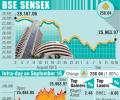
Investors didn't show much enthusiasm in the broader markets.

The market breadth was extremely weak with 1,806 losers against 1,009 gainers on the BSE.
The S&P BSE Sensex gained over 100 points and ended at 26147.33 while the CNX Nifty ended 27 points higher at 7,795.75.
The market for Shariah funds is set to grow with Benchmark Mutual Fund launching the first-ever Shariah Benchmark Exchange-traded scheme in India. It's an open-ended listed index scheme.
The S&P BSE Sensex shed over 255 points and ended at 25,062.67 while the CNX Nifty traded 76 points lower and ended at 7,493.20.
The benchmark S&P BSE Sensex declined 37.69 points, or 0.15 per cent, to end at 25,190.48 and the NSE CNX Nifty ended 8.55 points, or 0.11 per cent, down at 7,533.55.

Benchmark share indices ended lower, amid a volatile trading session, weighed by weakness among Metal, Banks and Capital Goods shares. Weak performance of the global markets also dampened the sentiments among local investors.
FIIs continue to invest in India, with their net investment since September 2013 standing at about Rs 82,000 crore(Rs 820 billion)
Markets reversed early losses and ended higher as investors picked up beaten down frontline stocks.

BSE Metal and IT indices plummeted by almost 2%

The market breadth was slightly in the negative. Out of the total 2927 total stocks traded on the BSE, 1388 stocks have advanced, while 1402 stocks declined.

The Nifty opened on a firm note and moved between 5,913 and 5,866 as investors awaited TCS and Reliance Industries results.

Benchmark share indices ended lower on Wednesday weighed down by selling pressure in bank shares on concerns of rising non performing assets in wake of the economic slowdown. Selling in metal and capital goods shares also dampened market sentiment.
In recent times, 'inflation' has emerged as a buzz word of sorts. Simply put, inflation is a situation wherein too much money chases a limited number of goods. This leads to a fall in the value of money. Inflation is often expressed as a rise in the price level. For example, a product that costs Rs 100 now, would cost Rs 105 a year hence, assuming that prices rise at 5 per cent annually.

The market breadth in BSE ended flat with 1333 shares advancing and 1393 shares declining.
Mid cap stocks (and subsequently mid cap funds) have been the worst hit in the recent stock market crash. Investors who added mid cap investments to their portfolios without understanding their true nature are a dismayed lot. Typically, mid caps are presented as an opportunity to make quick money; sadly, investors are rarely made aware of the higher risk involved. While there is no doubt that if identified correctly, mid caps can contribute significantly.
The markets had skid earlier in the day on the back of a dismal set of cues from the Asian front.
Investors fail to realise the potential of tax-saving investments in contributing towards wealth creation. As a result, it is vital that tax-planning be considered as a part of the investor's overall financial planning and not in isolation.
It was another good month for investors as equity markets surged northwards and touched record highs. The BSE Sensex posted a gain of 14.73% during the month to close at 19,838 points; the S&P CNX Nifty appreciated by 17.53% to settle at 5,901 points. The CNX Midcap rose by 8.49%, before settling at 7,450 points. However, these numbers conceal the intense volatility that was experienced during the month.
The month of September proved to be the most lucrative one in the calendar year so far, as equity markets set and breached record highs at alarming regularity. The BSE Sensex posted a gain of 12.87 per cent during the month and closed at 17,291 points; the S&P CNX Nifty appreciated by 12.48 per cent and ended at 5,021 points. The CNX Midcap rose by 13.62 per cent, before settling at 6,867 points.
A lot of NFOs were mis-sold and we frequently come across clients who request us to re-assess their NFO-heavy portfolios.

Overall market breadth was extremely positive as 1,695 stocks advancing while 831 were declining.
In the last five years, while gold prices appreciated 55.8% in dollar terms, in rupee terms, returns stood at 129%, primarily owing to the falling rupee.

Markets extended losses in the last leg of the trade and declined 1% due to selling pressure in financial and mining shares.

Foreign Institutional Investors have pumped in $2.2 billion or Rs 9807 crore in Indian equities in the past eight trading sessions.
 © 2026 Rediff.com - Advertise with us - Disclaimer - Privacy Policy - Sitemap - Feedback - About us - Terms of use - Grievances